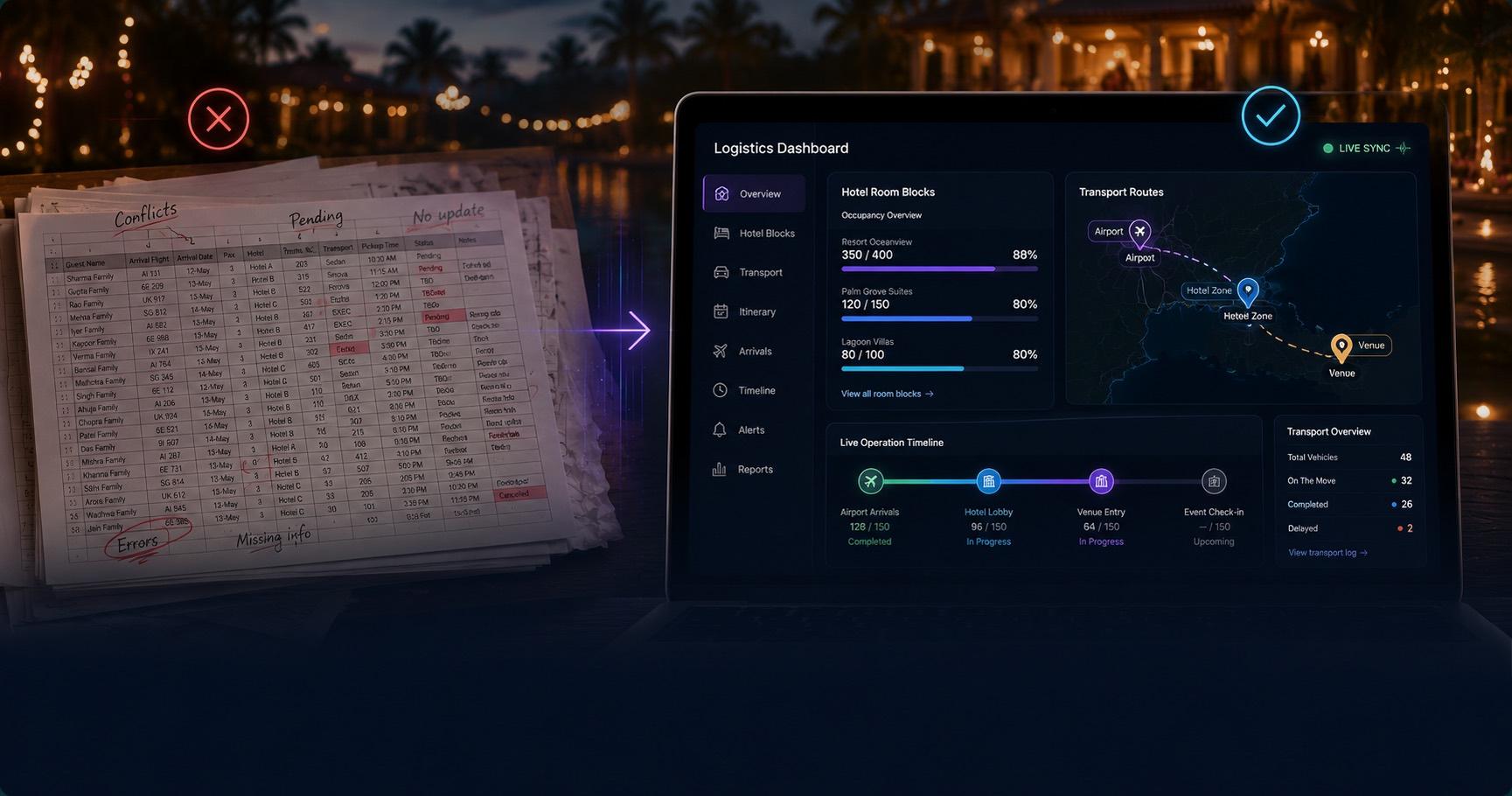
Why Logistics Dashboards Beat Spreadsheets for Destination Events
Hotel allocation, cab routing, and on-ground ownership need a live system, not a static sheet.
Cam-Events AI Editorial5 min read
Spreadsheets hide risk until it is too late
A destination event may begin with separate rooming, flight, vehicle, and guest sheets. Each can be accurate at the moment it is exported and still become wrong an hour later. RSVP changes affect rooms, flight delays affect pickups, and a vehicle replacement affects both the transport desk and the waiting guest. Static sheets show rows; they do not show which operational commitments are now at risk.
A useful logistics dashboard is not simply a prettier spreadsheet. It connects each movement and allocation to the guest record, highlights missing ownership, and shows exceptions by urgency. Coordinators should be able to move from a summary to the affected guest, trip, room, or service task without reconciling multiple files.
Hotel allocation at wedding scale
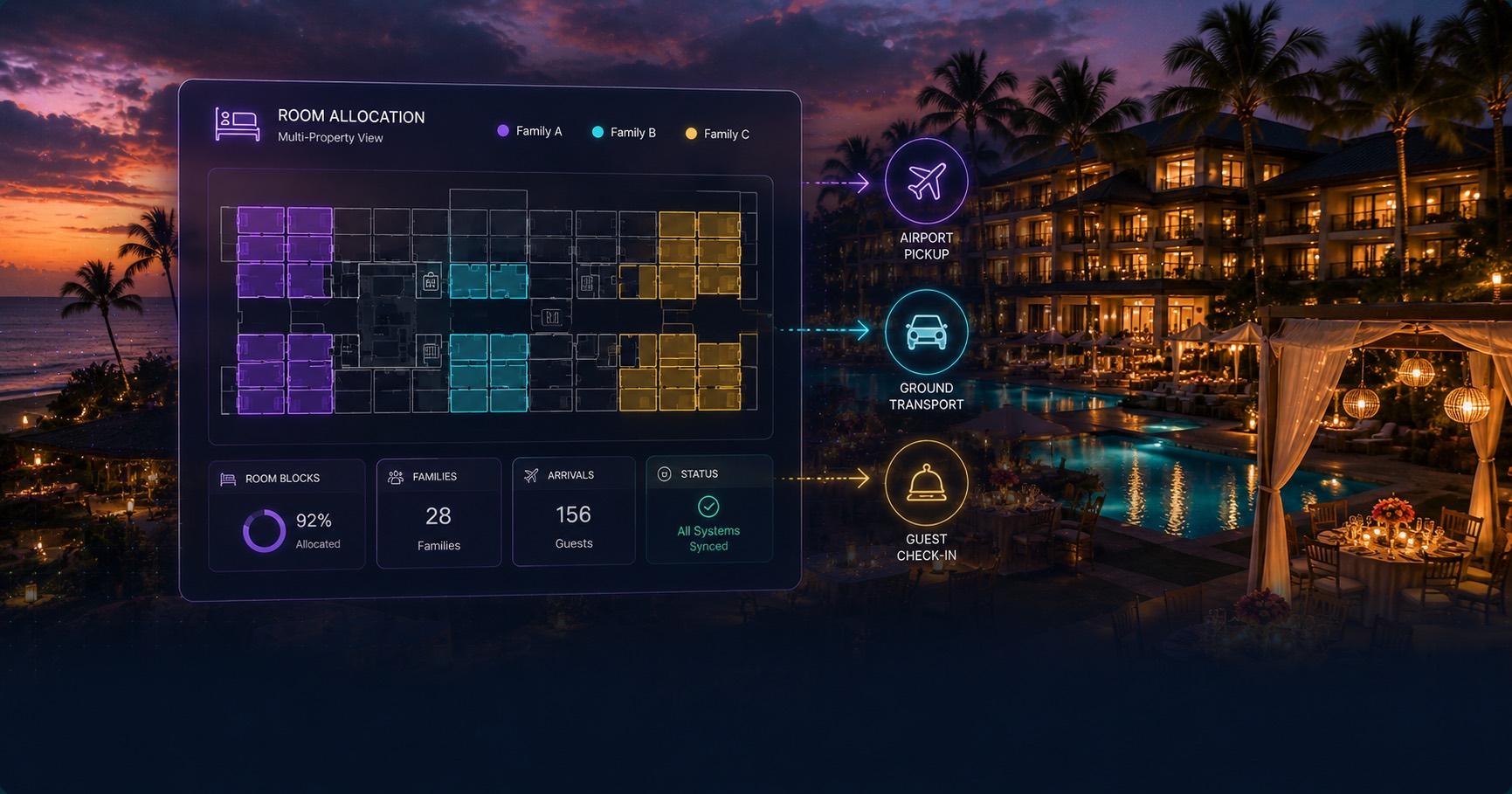
Start with the contracted room block by property, room type, occupancy rule, check-in and checkout dates, meal plan, and any protected VIP inventory. The system should distinguish contracted, held, assigned, confirmed by hotel, occupied, and released rooms. Without those states, an apparent vacancy may still be commercially committed or operationally unavailable.
Allocate families and roommates together while respecting occupancy, accessibility, senior-guest, and host preferences. Keep a revision history because rooming lists change repeatedly and hotels may confirm an older version. Hotel teams should work from property-scoped views and acknowledge changes instead of receiving uncontrolled spreadsheet attachments.
Turn travel details into arrival workload
Flight or train details become useful only after they are normalized into arrival date, scheduled time, terminal or station, origin, party size, luggage estimate, and pickup requirement. Group records into operational windows while preserving the ability to separate VIP, accessibility, or special-assistance movements.
External status data can help flag delays, but it should not silently overwrite the plan. Show the provider status, last checked time, and the coordinator's operational decision. When no live provider is configured, the system should make that limitation clear and support manual confirmation rather than displaying stale information as current.
Transport load and arrival windows
Plan arrivals and departures as trips with pickup point, destination, time window, vehicle, driver, capacity, passengers, route notes, and escalation owner. A driver should accept the assignment and update arrived, picked up, and dropped states. The transport desk needs to see unassigned guests, capacity conflicts, delayed movements, and vehicles that have stopped reporting.
Maps and route links are useful, but they do not replace dispatch decisions. Live location requires explicit operational use, a clear sharing window, and automatic shut-off after the assignment. ETA should show its calculation time and become an alert only when it affects a guest promise or downstream event function.
Make handovers explicit
Guests often move through several owners: airport representative, driver, hotel desk, porter, and VIP shadow. Each handover needs a simple confirmation and timestamp so the command center can distinguish a delayed transfer from missing data. Luggage jobs need custody and issue reporting even when photo, signature, or OTP confirmation is not part of the pilot.
Escalation should create a task rather than another chat message. Record the issue, affected guest or trip, current owner, severity, due time, and resolution. Supervisors need one view of unresolved exceptions across hotels, transport, check-in, and guest services so the loudest WhatsApp group does not set the operational priority.
Show decisions, ownership, and freshness
The best dashboard answers three questions: what needs attention, who owns it, and how fresh is the information? Useful summaries include unassigned arrivals, room conflicts, overdue trips, guests waiting beyond threshold, unresolved incidents, and field users whose last update is stale. Every count should open the underlying work queue.
Avoid decorative metrics that cannot be acted upon. A vehicle utilization percentage is less useful than knowing which confirmed pickup lacks a suitable vehicle. A room occupancy chart is less useful than seeing tomorrow's over-allocation by property and the guests affected. Operational analytics should shorten the path from signal to decision.
Roll out with a dry run
Before the live event, import a representative guest set, configure venues and hotels, assign sample trips, and walk each role through its mobile view. Test poor connectivity, duplicate scans, a delayed arrival, a room change, a replacement vehicle, and a supervisor override. Confirm who receives each alert and what happens when they do not respond.
After the dry run, lock the operating playbook: cut-off times, escalation contacts, data export rules, communication windows, and backup processes. Technology reduces coordination effort only when the agency agrees how the team will use it. A dashboard without an operating model becomes one more screen that staff ignore during the event.